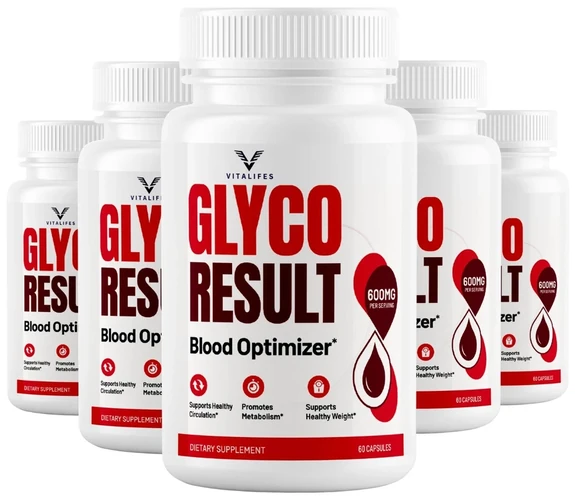
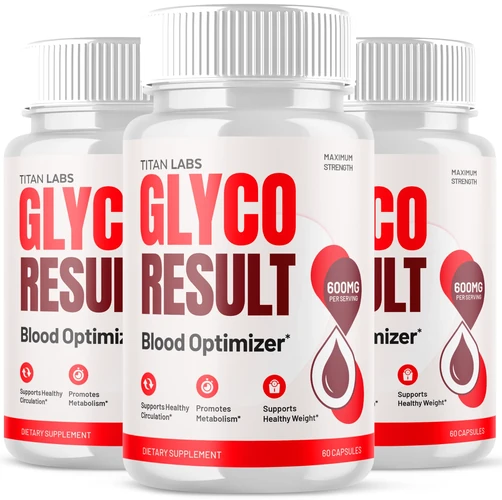
Glyco Result is a real capsule supplement from Titan Labs — 60 capsules, two a day, 600 mg per serving. What those 600 mg consist of is not published anywhere public, and on a blood sugar product that is the thing worth knowing before you order.
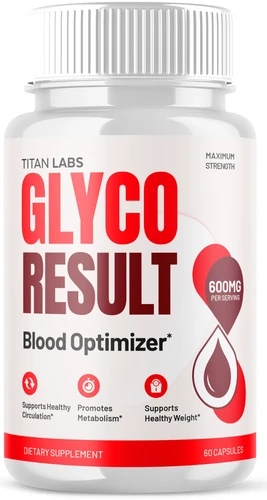
Glyco Result Blood Optimizer is a dietary supplement in capsule form from Titan Labs, sold in 60-capsule bottles at two capsules daily, delivering 600 mg per serving. The bottle states it supports healthy circulation, promotes metabolism and supports healthy weight. It is a real, orderable product. What is missing is the composition: no supplement facts panel appears on any public listing, and no finished-product clinical trial has been published. This page states what is confirmed and leaves the rest blank rather than filling it in.
| Format | Capsule — two daily, 60 per bottle, 30-day supply |
|---|---|
| Brand | Titan Labs, per the bottle |
| Serving size | 600 mg per serving, stated on the label |
| What those 600 mg contain | Not published — read the panel on the bottle |
| Per-ingredient doses | Not published |
| Stated on the label | Supports healthy circulation, promotes metabolism, supports healthy weight |
| Manufacturing | USA, GMP-certified facility per the product listing |
| Clinical testing | No published trial on the finished formula |
| Before you start | Show the bottle's panel to a pharmacist if you take glucose lowering medication (see safety) |
| Not | A diabetes treatment, or a substitute for prescribed medication |

The label states 600 mg per serving, so the amount is disclosed. What those 600 mg consist of is not. No supplement facts panel appears on the brand's retail listings, and three separate published reviews of this product each say the same thing in their own words. The composition appears on the bottle, and currently nowhere else.
That is unusual enough to be worth showing rather than summarising. Of the three reviews that exist:
One writes that "the exact proprietary blend composition was not fully detailed in available product listings" and then describes what formulas in this category typically contain — not what this one contains.
A second says the product is "likely formulated with" botanical extracts and mineral compounds, and that the documentation "does not appear to provide a comprehensive breakdown of proprietary blend components or individual ingredient quantification".
A third runs an entire section headed "Unclear Ingredient Dosages" and closes by telling readers to read the ingredient label carefully when it arrives.
Every other product page in this category prints one. Most of them are guessing — taking the ingredients that usually appear in blood sugar supplements and presenting them as this product's formula.
That is not a small liberty. A list you cannot verify is worse than no list, because it looks like information. If you took a printed list to your pharmacist and it turned out to be someone's guess at what is probably inside, the conversation you had would have been worthless.
So this page leaves it blank. The bottle has the panel. Read that.
Because an undisclosed formula cannot be checked against your medication. Many botanicals used in this category lower blood sugar in their own right, and stacked on top of metformin or insulin they can push it lower than intended.
This is the practical consequence, and it is specific to this category rather than a general caution. Berberine, gymnema, bitter melon, cinnamon, alpha lipoic acid and chromium all appear routinely in blood sugar formulas. Several of them have genuine glucose-lowering activity. That is the point of them.
If you take a glucose lowering drug, the sensible move is to hand the label to a pharmacist and let them look for interactions. You cannot do that with a formula nobody has published. You can only do it once the bottle is in your hand.
So if you are on medication, the order of operations is: order, read the panel when it arrives, take it to the pharmacy, then take the first capsule. Not the other way round.
And the thing that is never negotiable: do not stop, reduce or skip prescribed diabetes medication because of a supplement or an advertisement. If anything you have read suggests you can, treat that as a reason to close the page. Full safety page →
Seven things are stated on the bottle or the brand's listings. Five significant things are not stated anywhere. Here is the split, without either side dressed up as the other.
Glyco Result is a dietary supplement in capsule form from Titan Labs, sold in 60-capsule bottles at two capsules daily. It is positioned to support healthy glucose metabolism in adults alongside diet and activity.
The marketing describes it as supporting blood sugar already within the normal range, insulin sensitivity, energy production and carbohydrate metabolism. Those are structure-function claims, which is the language supplements are legally allowed to use — they are not claims to treat anything.
The people who look at this category are usually doing the sensible things already: watching what they eat, walking more, keeping an eye on their numbers. A supplement sits alongside that work. It does not replace it, and the evidence base for this whole aisle is thinner than the advertising implies. Read the longer explanation →
No. No published peer-reviewed clinical trial evaluating the finished Glyco Result formula could be located. What exists is research on individual ingredients — and since the ingredients are not disclosed, even that cannot be applied here.
Worth setting the wider context too. The NIH's National Center for Complementary and Integrative Health states that, overall, there is not enough scientific evidence to show that any dietary supplement can help manage or prevent type 2 diabetes. That is the most authoritative summary available for this entire category, and it is linked in the sources at the foot of this page.
NCCIH also notes multiple case reports linking dietary supplement use to kidney disease — a particular concern here because diabetes is the leading cause of chronic kidney disease in the United States. If your kidney function is being monitored, that is another reason to involve your clinician rather than starting independently.
It appears to be a real dietary supplement rather than a scam. It exists, it ships, and it is listed on major retail marketplaces as well as through the official channel. The fair criticism is narrower than "scam" and more useful.
The criticism is this: the formula is not disclosed, no finished-product trial exists, and the advertising makes broader claims than either of those supports. That is not fraud. It is a transparency gap, and it is common across this category rather than unique to this brand.
What it means practically is that you should judge it as a low-information purchase with a refund window attached, rather than as something proven. Buy it if that trade seems reasonable to you. Do not buy it expecting clinical results, because nothing published supports that.
Made in the USA in GMP-certified facilities, non-GMO, gluten free and free from common allergens. These are the brand's stated claims, and they concern how it is made rather than what it does.
Made in the USA
Manufactured in the United States per the product listing.

GMP certified facility
Good Manufacturing Practice certification covers hygiene, batch records and label accuracy.
Non-GMO, gluten free
Stated free from common allergens on the product listing.
Not FDA approved
No dietary supplement is. Facility standards describe how a product is made, never whether it works.

GMP certification tells you a facility follows documented processes. It says nothing about whether the formula inside does anything, and it is not a substitute for the ingredient panel that is missing here.
Two capsules daily with water, per the product listing. One 60-capsule bottle is a 30-day supply. Follow the directions printed on your own bottle rather than anything written here, and do not exceed the stated serving.
There is one step specific to this product, and it comes before the first capsule: read the supplement facts panel on the bottle. That is the only place the formula appears. Photograph it while you are at it — it makes the pharmacist conversation quicker, and it gives you a record if the formula changes between orders.
If you monitor your blood sugar, keep monitoring and keep the readings. That is the only way you or your clinician will know whether anything has actually changed. Supplements in this category work over weeks and months, if at all.
Two bottles work out at $79 each, falling to $69 per bottle on three and $49 per bottle on six. Confirm the current total on the checkout page before you pay — promotional pricing in this category changes often.
Two things worth knowing before you choose a tier. Pricing and guarantee terms are set on the checkout page and can change with promotions, so read them there rather than relying on the figures above. And products under this name also appear on major retail marketplaces at considerably lower prices — worth a search before committing to a multi-bottle order, since that is money either way.
Less than the advertising suggests, and that is worth saying plainly. Without a disclosed formula or a finished-product trial, nobody can tell you what this specific product will do. What follows is how the brand positions it, labelled as such.
The brand's core positioning. Framed as support for blood sugar already within the normal range.
Claimed in the marketing. No finished-product evidence exists for this or any other claim here.
Also brand-stated. Common positioning across this whole category.
Two capsules, no preparation. The one thing that is genuinely reliable about a capsule.
Diet, movement, weight, sleep and prescribed treatment do the heavy lifting. Nothing in a bottle outperforms them.
Which is, honestly, the most concrete thing on offer when the formula is undisclosed.
“I photographed the label when it arrived and showed it to my pharmacist before starting, which is what I would tell anyone to do. Easy enough to take with breakfast.”
“I keep a log of my morning readings, which I would recommend over going on feel. Two capsules a day is simple and I have stayed consistent with it.”
“Nothing dramatic, and I did not expect it to be. I would have liked the ingredient list published before ordering rather than finding it on the bottle.”
Customer feedback describes individual experiences. It is not typical, and it is not evidence that the product works. Any rating displayed for this product comes without a named review platform or verified review count — read it as brand-reported rather than independently audited.
With the formula undisclosed and no finished-product research, the refund window is the most concrete thing attached to this purchase. It is worth reading properly rather than glancing at.
Check the terms on the checkout page before you pay: how long the window runs, whether it starts at purchase or delivery, whether a return is required for a full refund, and whether any restocking or processing fee applies. Keep your order number and confirmation email either way.
See Packages
A real capsule supplement with an undisclosed formula. If you take glucose lowering medication, the panel on the bottle goes to a pharmacist before the first capsule does.
A dietary supplement in capsule form from Titan Labs, sold in 60-capsule bottles at two capsules daily. It is positioned to support healthy glucose metabolism in adults. It is a dietary supplement, not a diabetes medicine.
The ingredient panel is not published. No supplement facts appear on the retail listings, and three separate published reviews of this product each state that the formula is not disclosed.
The panel is printed on the bottle. That is currently the only place it appears, which is why this page does not print a list — any list published elsewhere is a guess at what products in this category usually contain.
Because you cannot check it against your medication. Many botanicals used in blood sugar formulas lower blood sugar in their own right, and stacked on metformin or insulin they can push it lower than intended.
Without knowing which are present, neither you nor your pharmacist can assess that in advance. Read the panel when the bottle arrives, take it to the pharmacy, and only then start.
No. No published peer-reviewed clinical trial on the finished Glyco Result formula could be located. The NIH's NCCIH also states that overall there is not enough scientific evidence to show that any dietary supplement can help manage or prevent type 2 diabetes.
No. It does not diagnose, treat, cure or prevent diabetes, prediabetes or any other condition, and it is not a substitute for prescribed medication or medical care.
Never stop or change prescribed diabetes treatment because of a supplement or an advertisement. If any ad suggests you can, close it.
It appears to be a real dietary supplement rather than a scam — it exists, it ships, and it is listed on major retail marketplaces. The fair criticism is that the formula is not disclosed, no finished-product trial exists, and the marketing claims more than either supports.
Two capsules daily with water, per the product listing, making one 60-capsule bottle a 30-day supply. Follow the directions printed on your own bottle rather than anything written here, and do not exceed the stated serving.
Products under this name also appear on major retail marketplaces, often at considerably lower prices than the multi-bottle funnel pricing. Worth a search before committing to a large order. Note that guarantee terms differ by seller, so check what applies wherever you buy.
These references concern dietary supplements and type 2 diabetes generally, not this product specifically — no research on this formula exists to cite. They are listed so you can read the underlying position yourself. Their inclusion does not indicate that NCCIH or the NIH endorses, recommends or is affiliated with Glyco Result.